
[Transcript from Episode]
Kyle Pierce: [00:00:00] In 2011, a young physics graduate launched what would become the most infamous black market on the internet: Silk Road—a billion-dollar empire built in the shadowy recesses of the dark web, which, for a time, threatened to undermine the very foundations of the economic, social, and political authority of the United States government.
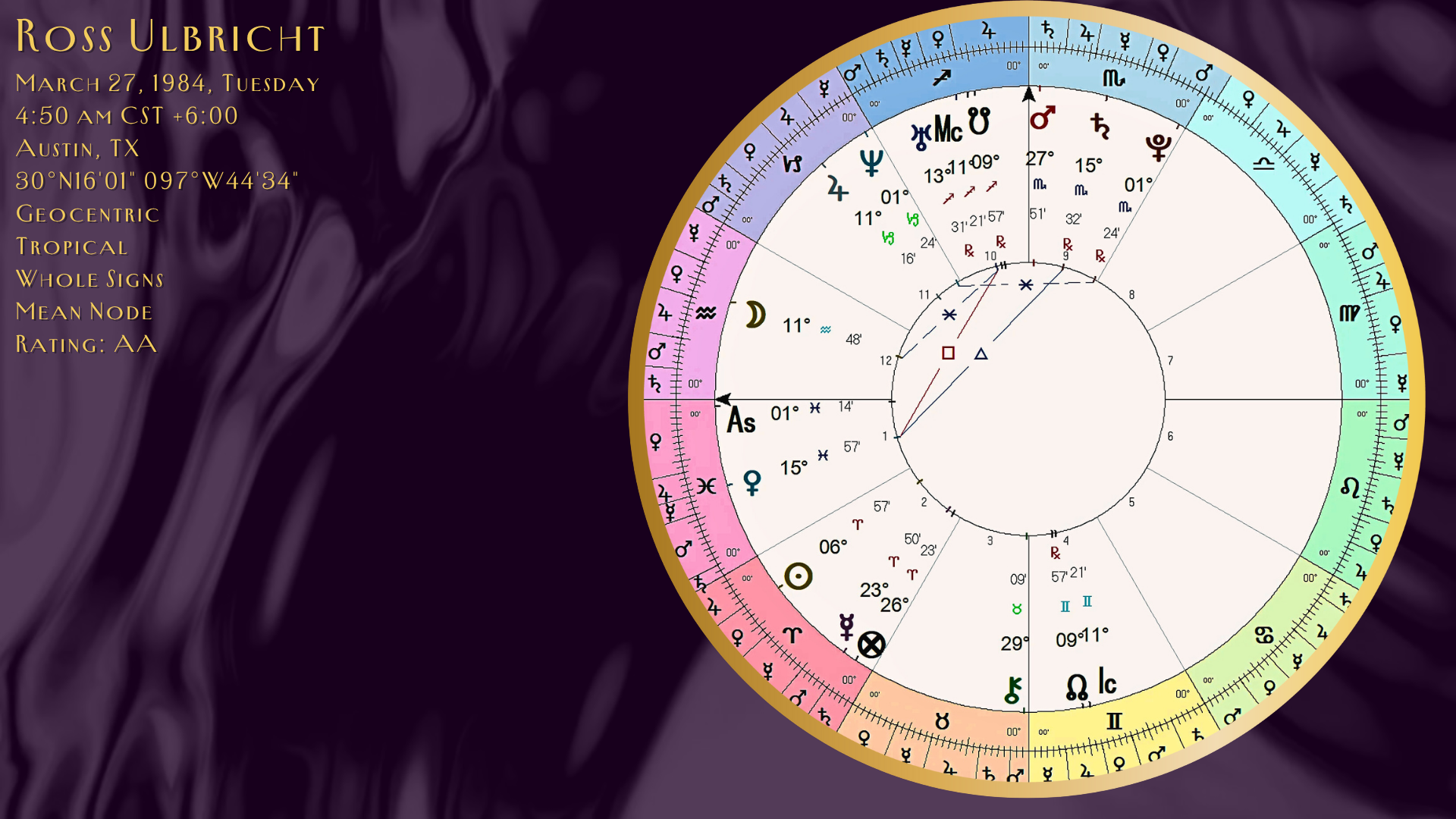
In the first episode of this series, we’ll be introducing some of the main planetary influences in Ross Ulbricht’s birth chart, and how they speak to his character, life circumstances, and motivations for embarking on the fateful enterprise that would change his life forever.
Finally, it should be noted that since the initial recording of this first installment, major events have taken place which have drastically altered the trajectory of Ross Ulbricht’s life. On January 21st, 2025, Ross was granted a full pardon by President Donald Trump, following a campaign promise made at the 2024 Libertarian National Convention.
An event with intriguing and [00:01:00] profoundly appropriate astrological context—which will be explored later in the series. With that, I'm Kyle Pierce, and this is Killer Cosmos.
Who Is Ross Ulbricht?
Kyle Pierce: Ross Ulbricht was the founder of a dark web marketplace called the Silk Road, which essentially functioned as a giant black market on the internet—where people could buy and sell drugs, weapons, and potentially any number of illegal goods or services, with very little risk of being caught by the authorities.
The Silk Road operated on the Tor Network, which made the tracing of IP addresses virtually impossible and allowed users to maintain anonymity. Transactions were conducted using Bitcoin. But in 2011, when the Silk Road was launched, very few people were familiar with even the idea of [00:02:00] cryptocurrency.
During the two and a half years that the Silk Road was active, it’s estimated that between $200 million and over $1 billion in transactions took place. The platform played a crucial role in introducing the world to the idea of cryptocurrencies—most specifically, Bitcoin.
Countless similar marketplaces have since run on the dark web, inspired by Silk Road—quite possibly changing the trajectory of the United States’ War on Drugs forever.
As a result, Ross Ulbricht has become something of an icon—and sort of a martyr—for the cryptocurrency community, for groups that advocate against the War on Drugs, and within the libertarian community. It was Ross Ulbricht’s libertarian philosophy and political beliefs that inspired and motivated him to create the Silk Road.
After Ross was arrested in October of 2013 and the Silk Road was shut down, he was ultimately [00:03:00] convicted of a slew of charges—including engaging in a continuing criminal enterprise, distributing narcotics, money laundering, and computer hacking—all of which were prosecuted under the federal kingpin statute. Which basically means they can throw the book at you.
And they did.
They sentenced Ross Ulbricht to two life sentences without the possibility of parole, plus an additional 30 years or so. At the time of his sentencing, Ross was 30 years old.
Now, many believe the sentence to be incredibly harsh, given that he was a first-time offender. These were non-violent crimes, and there are many who advocate that Ross Ulbricht should be freed—or at least granted a reduced sentence.
At the time of this recording, Donald Trump—who promised to commute Ross Ulbricht’s sentence to time served on day one of his presidency, if elected—has yet to deliver. That could change at any time, and it will be one of [00:04:00] the many things we’ll assess Ross Ulbricht’s birth chart for indications of.
But without further ado, let’s take a look at his birth chart and see how it speaks to who this guy is.
The Birth Chart of Ross Ulbricht: Pisces Rising
Kyle Pierce: Ross was born on March 27th, 1984, at 4:50 AM in Austin, Texas. And let's just start with the basics. We have Ross with Pisces Rising, which, at a very broad level, will describe somebody whose sort of framework for engaging with the world is, in some way, fundamentally Piscean, right?
What? What's that mean? You could say, essentially, someone with Pisces Rising is trying to assimilate the totality of lived experience into a broader context. There’s an inherent willingness—and really, a motivation—to understand condition and experience, and to seek to find a sort of harmonious flow.
There’s a freedom-seeking [00:05:00] with Pisces—an aim to allow for the flow of good, what is desirable, what is uplifting. Through the lens of Pisces, we understand reality as a continuum of states that is perpetually changing, and that to hold onto a state—or to resist what can be identified as a natural flow within the grand context—is antithetical to what is desirable.
This is mutable water, which changes from one state to another and returns back again. And because it's Jupiter-ruled water, it wants to flow, if you will, toward what is good, what is ideal. So, to bring it down to earth, right? It's—you know—Pisces Rising people like to be able to move freely, and there's a sensitivity to what might box them in, right?
The fish—they swim and they flow with the current. They're seeking to maintain connection with the whole rather than be pulled out of it or trapped in some alcove [00:06:00] within it. Whether the scope of reality is a small fish tank or an entire ocean, we want to understand what that is and exist harmoniously within it.
And being Jupiter-ruled, we want to move toward the positive. But in order to move toward the positive, we have to identify what's negative or undesirable—and not be there. Or if we are there, we want to understand what it means to be there and connect it to the greater totality of being, right?
And that's why people like to call Pisces people dreamy. Many do fall into the category of dreamy, but in a sense, there's always kind of one foot here in present reality, and another foot in the unseen—in the abstract space of meaning, which can only be established in context.
Venus in Pisces’ Influence in Ross Ulbricht’s First House
Kyle Pierce: Now really, the sign by itself can only tell you so much, and you want to look at what is influencing, you know, the way Ross Ulbricht does Pisces.
And one of the first things you might notice is that Venus is in Pisces [00:07:00] in his first house. So it’s speaking directly to who he is—how he shows up, how he orients himself in the world, and what, you know, motivates him, right?
And you know, typically, when we think of drug kingpins—overseers of criminal empires—we don’t think of Venus. Venus is the planet that signifies love, beauty, harmony. She represents an influence that wants to connect and get along with the world—right? With people—and wants to partake in what there is to be enjoyed: likes to eat, drink, and be merry.
Venus is one of the two benefics, right? And to a large degree, it's the good that is lived on a day-to-day basis or can be found within the material world—which can be money, which can be good food, good conversation—you know, all the things that bring pleasure and joy.
And we really like Venus in Pisces in particular because Venus is said to be exalted in Pisces. This is the sign where we get the highest expression of [00:08:00] Venus. So, Venus is the planet of love. It’s like unconditional love—beauty not as a state of perfection, but as an expression of the truth of who somebody is, or what something is—which entails acceptance of the totality of it, right?
In Pisces, we're not attached to details—we're looking at the whole. The whole of the being, right?
So you plop a Venus in Pisces in somebody’s first house, you're going to tend to get somebody who's very kind, tends to make friends easily, who gets along well with others. Probably considered attractive by most conventional standards—but isn't overly attached. Sort of a roll out of bed and look beautiful Venus. “How you doin’?”
One of the things that has been said about Ross Ulbricht time and time again is that he is a generally kind person. He is also very, very sweet and compassionate, and cares about people. And—very easygoing, very friendly—like, just really, um… [00:09:00] a nice, a nice guy.
Many described his character as wholesome—even. The funny thing, actually, is that he rarely used profanity, even in his documented conversations with drug dealers and hit men. He’d say things like, “Golly geez,” “Heck,” right?
He has been more or less unanimously described as a really nice guy. That Venus in Pisces in the first house is pretty strong testimony to that.
Now, one of the many things that having Venus in the first house will do for you is provide you with a sort of baseline luck or good fortune. Because not only is Venus a benefic planet—right, a good-doer, a positive influence—it’s also in a really strong sign for Venus. One which facilitates her delivering really high-quality results in arguably the most potent part of the chart—the first house.
So, just as a starting point, you are looking at somebody who, all of these things aside, is more [00:10:00] lucky than most—or at least starts off life in a more favorable position.
And Ross did grow up in good, upper-middle-class circumstances. By all accounts, his home and family life were positive. His dad is an architect and designer—so he designs and builds houses. He built houses in Costa Rica, and so Ross was always, like, you know, had a really great life.
Not only was he born to privileged circumstances, he also had many personal assets which eased his way through life: good-looking, he was friendly, he got along well with everyone, and everybody liked him.
He’s also very intelligent. He developed an early interest in mathematics, which isn’t always the first thing that comes to mind when you think of Pisces. And I think, to a large degree, it can be found elsewhere in the chart.
However, Pisces is not a place where we prioritize normal language, right? Oftentimes the things in Pisces are better expressed [00:11:00] through things like poetry or music. However, Pisces’ orientation toward the universal—I’ve found that many people with planets in Pisces develop an appreciation for mathematics as a sort of universal language. But more on that later.
You can definitely understand, at a baseline, that Ross was gifted both personally and circumstantially, which set him up to be capable of doing many things. And by the time he graduated high school, he received a full academic scholarship to the University of Texas, and the world was, in many ways, his oyster.
Right?
Now, I want to go on to think about Ross—even as he was getting perfect grades, getting scholarships, and getting degrees—he also had a great appreciation for mind-altering substances.
Often with Piscean stuff, there's an interest in the altered state of consciousness, right? And drugs can be a natural or unnatural pathway to achieving that.
Many friends have [00:12:00] reported that he very much enjoyed taking mushrooms, wandering around in nature, and taking his clothes off. It’s Pisces, right? It’s moving into a state of appreciation of nature without the encumbrance or limitations of clothing.
He also very much liked to, you know, smoke weed and that sort of thing. But by all accounts, there’s no indication that he had, like, a substance abuse problem—which we might expect with Venus in Pisces. Being able to, you know, appreciate what there is to appreciate—right?—but without getting attached to it in an unhealthy way, at least in terms of maybe addiction.
He also seemed to avoid hard drugs himself, and mostly just enjoyed doing sort of hippie stuff—going to drum circles and surfing, you know, hanging out and just vibing, right?
The Origins of Ross Ulbricht’s Libertarian Ideology and the War on Drugs: Saturn in Scorpio in the 9th House Trine Venus in Pisces
Kyle Pierce: And if that was the whole story, he wouldn't be the subject of a Killer Cosmos episode. But as we can see—that’s not the whole story in the chart.
I think we need to start with the extremely close trine that Venus [00:13:00] is in with Saturn in Scorpio in the ninth house. Now, typically, we don't think of a trine as being a problematic aspect. Planets that are trine, uh, agree with each other and support each other in their endeavors.
And one of the things we’ll want to consider with Saturn is that, because Ross was born at night, Saturn is the out-of-sect malefic. Which means that Saturn is a… a less constructive kind of problem. Obviously, we can't—and won’t—say that everything Saturn signifies is terrible and awful. However, part of what that means is that Saturn is just a little more extreme, and more extreme in a way that pulls the life in a direction that is not especially helpful—or that pulls the life out of moderation, outside of the middle.
So what might Saturn be describing? Well, Saturn is in the ninth house, right? So it has something to say about how Ross sees the world—what his beliefs about the world are. And… well, so what is Saturn? [00:14:00] Saturn is characteristically critical. It's negating. Doesn’t usually have a lot of positive things to say. It's looking at problems—and especially in a night chart, it's pointing to problems that are more deeply entrenched.
Right?
So, what kind of problems did Ross Ulbricht see in the world that were deeply entrenched—and maybe had something to do with structure? Right? Saturn builds walls, creates hierarchies and bureaucracies, and complexes which control and sometimes stifle—or negate—the flow of things. The movement of things.
This went beyond just, you know, legalizing marijuana—or even heroin. He wanted to see a new relationship between individuals and the government—where the government was, you know, basically hamstrung, and couldn’t control what people bought and sold.
In Scorpio, we’re dealing with the flow of more complex water, right? Perhaps the flow [00:15:00] of desires—the underground flow of things that are deeply wanted, that must be had—or feel like they must be. And sometimes… they shouldn’t be.
On one level, Saturn is representing perhaps the government’s oppressive laws against—we’ll say—drugs. Not everything about Scorpio is drugs, but illicit drugs are some of the many things that can show up in Scorpio. We get underground or below-the-surface activity. So maybe Saturn represents a government trying to put limits—impose limits—on the things that flow… on the underground.
Right? And in a night chart, we don’t tend to like Saturn as much. We experience Saturn as being too oppressive, too harsh, unfair. And while Saturn represents the structure itself, it also represents the experience of the structure—being critical of it.
And it was while he was in college—and his ninth house—that he developed his libertarian views. Part of that framework is the understanding [00:16:00] that, you know, the government is oppressive and creating obstacles which hinder expansion and growth. The free market, right?
Venus likes places of exchange. Venus in Pisces would like a free-flowing market, right? So Venus looks at Saturn and says, “Yeah, dude—that’s bullshit. I hate how the government’s always creating regulations which make it hard to start businesses and make money.” Which is a big part of Ross’s story, you see.
Ross Ulbricht’s Entrepreneurial Ambitions: Jupiter in Capricorn in the 11th House
Kyle Pierce: While he was in school and adopted these libertarian political beliefs, he developed an ambition to become an entrepreneur. There are a lot of people who would never start their own business—but Ross? Sure. You know, why not?
We do get Jupiter in the 11th house ruling the 1st, which has a big role to play in describing who Ross is, as well as his life trajectory. And one of the many things we like to do in the 11th house is start profitable ventures. It's a profitable house.
Jupiter’s also in [00:17:00] Capricorn, which is an orientation toward the physical—the necessities of life. Making money, doing the practical thing in the world, and building. In Capricorn, we’re shaping the hard, cold earth into mountains, into pyramids, into castles, right? We're trying to understand: what are the laws? How is money made? What do people want to buy? What do people need? What are the cold, hard facts of how shit gets done?
So, because Jupiter is in Capricorn, it's receiving signification from Saturn. Saturn is in charge of Capricorn, so it's describing what's happening there—or giving us the subject or the topic of what Jupiter, what Ross, is doing in the 11th house. It’s describing the context—or maybe the environment—or what is being responded to.
And we’ll get to that more.
But let’s focus a little bit more on Saturn first.
Fighting Against Oppressive Structures: Mars in Scorpio in Ross Ulbricht’s 9th House
Kyle Pierce: We have to look at the fact that Saturn is with Mars in Scorpio. [00:18:00]
While Scorpio is not really a Saturn-friendly sign—Saturn doesn’t have official business there. It doesn’t rule the sign, it’s not exalted, and it doesn’t have any other forms of rulership—except for the last part: Saturn’s bound in Scorpio. Which Mars happens to be in. Which is interesting.
But Mars does rule Scorpio. So Mars knows how to get what it wants in Scorpio—and maybe more literally describes what might be a war in that space. It’s Mars and Saturn together in Ross’s ninth house. With Pluto, no less.
Ross’s experience—looking up at the ninth house, looking up at the world—and seeing kind of a fucked-up place, right? Or, stuff that he doesn’t like. He sees, perhaps, a War on Drugs. Right? Mars is the conflict. But what do we do when there’s a war? We fight back, right?
It’s perhaps speaking to a willingness to fight on behalf of his beliefs—or in resistance to the Saturn that’s hanging out in that [00:19:00] space. That, from Mars’ perspective, doesn’t belong there.
But also worth noting, when we’re looking at what Mars is doing here, is that on the day he was born—March 27th—Mars is direct. It looks like it’s going forward. However, it’s moving rather slow. In fact, it’s moving so slow, it’s almost not moving at all. And about a week or so after he was born, Mars stationed and began moving backward.
So this Mars is kind of like: “Wait a minute. I don’t think I like what’s going on. Maybe I need to go back and do something,” right? “I have unfinished business in previous degrees. I gotta backtrack.”
That slowing down is a sort of point of increasing ambivalence before Mars goes back—and decides to change direction. Literally move against what’s established—and eventually move back. Take on Saturn.
Perhaps it adds a bit of emphasis to what Mars is doing. And certainly—while he did complete his first [00:20:00] degree in physics—it was after getting his physics degree that he started reconsidering his life path and seeing his role in the world as one that must involve resisting the suppressive system that he saw, and live in accordance with his libertarian political philosophy.
Which—when we see that Mars rules his second house—adds an extra layer of speaking specifically to economic topics. And it was during that period in his life that libertarian economic theory became a really big part of how he viewed himself as an agent in the world.
And it was a very huge part of why he created the Silk Road.
Which—how many ways does Ross’s chart describe the Silk Road? I mean, count the ways. Ow. It’s truly spelled out ten ways till Sunday—if that’s even a term.
But often, when I think about Scorpio, I like to think about Mordor from the Lord of the Rings series. If you’re familiar—Mordor was the place where all the orcs lived. And, you know, it was scary and dangerous. And if you wanted to travel through Mordor—or just operate there—you wanted ranger skills, right?
You wanted Viggo Mortensen escorting you through Mordor. Protecting you.
And that’s essentially Mars, right? Mars ushers you through the danger. Fights if a fight needs to happen—but avoids unnecessary fights. It moves around the danger—or underneath it—and perhaps undermines it, or, you know, sneaks up from behind and cuts its throat.
Able to move through Mordor. But also—if it needs something there, it can get something there. It wants some drugs? Mars can get in there and get out. It can get its needs met.
Mars is the sect malefic for Ross—so, the malefic that is more constructive, that tends to serve the interests of the individual’s life more—or at least we experience it that way. [00:22:00]
For Ross, that’s Mars.
So Mars likes the idea of fighting back against this monstrosity—as he sees it—that is not only limiting the free flow of people just doing what their will is, having their desires fulfilled, but also making it more dangerous by pushing it underground.
By making it illegal, it actually creates a place outside the law that is inherently more chaotic, more dangerous, more toxic, if you will.
This is what this all speaks to.
Ambition and Hubris: Jupiter in Its Fall in Capricorn in Ross Ulbricht’s Birth Chart
Kyle Pierce: So, with Saturn and that whole story in the ninth house sort of guiding Jupiter’s actions in the 11th, right? Jupiter—or Ross, we’ll say—was very interested in becoming an entrepreneur, as is considered a desirable and respectable activity or role in life to play, according to libertarian philosophy: to be a free economic agent.
And that is what Ross did for the first half of his twenties—was try to start businesses. And he started a bunch of 'em. [00:23:00]
Now’s probably a good opportunity to consider what the general condition of Jupiter is in Ross’s 11th house, ruling his Ascendant and telling a big part of the story. One of the main things we’re considering is that Jupiter is in the sign of its fall in Capricorn. And when planets are in the sign of their fall, they tend to get the wrong idea about things—or tend to get stuck. It doesn’t mean they never succeed or can’t—but the sign is sort of built to confuse the planet.
Jupiter is a planet of expansion, growth, hope, inspiring people, uplifting people. And essentially, Jupiter ends up bringing its idealism, optimism, and—for lack of a better word—privilege. Jupiter speaks to those who are blessed with the internal and material, circumstantial resources to be able to have things like ideals—to dream of something more than what is.
Jupiter brings [00:24:00] that to Capricorn—a place where things don’t get done that way. They don’t get done by inspiration and idealism and good luck. They get done by hard work, by existing structures, and by practical—and sometimes harsh—considerations. The cold facts.
Succeeding in Capricorn requires respect for the structures in place. And only when you humble yourself before those structures can you carefully begin to climb them—and maybe build on top of them, or reform them from within.
You can’t inspire people into moving mountains. You might be able to inspire them to work hard enough to, you know, carefully dig—shovel by shovel—every bit of dirt in the mountain and relocate it painstakingly over an agonizing amount of time. But that’s Mars-Saturn stuff. That’s not what Jupiter does—or how Jupiter operates.
And we can see this with Ross Ulbricht. He, in a sense, entered a world sort of unknowingly—well, idealistically—and just opened the floodgates. [00:25:00]
Without, perhaps, full consideration—or, and here’s the kicker—proper respect for the powers and structures that be. Capricorn is not a place where you judge whether the mountain is right or wrong to be there. It just is there.
Ross Ulbricht started the Silk Road with the intention of quite literally undermining the power and authority of the U.S. government. His stated mission was to completely bypass the United States’ drug laws, create a marketplace the government couldn’t touch, and basically make it so impossible for the U.S. to prosecute the War on Drugs or enforce limitations on what people can put in their bodies that they would just have to surrender and give up.
Say, “Well… since we can’t stop you, I guess we’ll just have to let you do your thing,” right?
And think about governments, right? Especially very powerful ones. They really don’t like it when you try to undermine their authority—not only break the law, but try to make them look stupid. [00:26:00]
Governments don’t like to look weak—and for practical reasons. If the authority of the government gets questioned long enough, its legitimacy weakens. That weakens its hold on society.
And at least certain iterations of the libertarian agenda see that as paving the way to a golden age of liberty. But when you eliminate a source of authority, a vacuum exists—and something else comes and takes its place.
It’s a very dangerous thing to challenge the authority of the most powerful government in the world. And quite literally, that’s what’s being described in Ross’s birth chart—with Jupiter in its fall in Capricorn. With Neptune, no less—which adds a certain level of ungroundedness or unrealistic expectation, maybe motivating things.
And I imagine Ross would agree—that he got in over his head. His [00:27:00] part-entrepreneurial endeavor, part-political revolution, blew up quite a bit bigger than he was prepared to deal with. His ideals and good intentions weren’t enough to either defeat or evade the United States government.
Incarceration: Moon in Aquarius in Ross Ulbricht’s 12th House
Kyle Pierce: And to a large degree, we’re able to see his current situation—at least at the time of recording this—by looking at the condition of the Moon.
In a night chart, the Moon especially tends to pull a person’s life in its direction—because that’s where the light is. We tend to move toward it. And Ross had the Moon in Aquarius in the 12th house.
The 12th house is traditionally described, very literally, as a place of incarceration. A place of imprisonment. A place of loss of agency. It’s not always that literal, but it does describe parts of our life—or our subconscious—that tend to elude our grasp.
We don’t [00:28:00] experience a default, large amount of agency in the 12th house. And while most people’s 12th houses don’t lead them into prison, we can see that for Ross, this was the case—especially when we see the Moon applying to a square with Saturn.
A square is a harsh aspect, and Saturn in many ways represents those laws and structures which are hard. And if you defy them without due consideration or respect, they will smack you back down. Saturn can signify imprisonment or confinement.
So the Moon is receiving a square from a planet that can signify law, prison, and confinement—in a sign that’s ruled by the very Saturn that represents all these laws that Ross needed his mission to undermine. And to liberate people from.
Which, in Aquarius, to a large degree—that’s what we’re trying to do. We’re trying to build a world outside of the walls. We’re seeing what is and saying, “Oh, that sucks. Fuck that. Let’s make something new.”
But unfortunately, we can see that that freedom-seeking Moon in Aquarius is overcome—or dominated—by Saturn. [00:29:00] Saturn is in the superior square. That makes Saturn the boss. The Moon doesn’t win, in this case.
However, there is quite a bit more to the story—and more to this chart.
And if you stick around for part two of this series, we’ll take a look at the influence of the Sun and Mercury in Aries, and we’ll explore more thoroughly the specific conditions and planetary dynamics in his chart that end up describing what is… a much more nuanced story and outcome than just a well-meaning but misguided idealistic kid who accidentally starts a drug empire and ends up in prison.
And some of these details might suggest that the story is far from over.
So tune in next time—and thanks for [00:30:00] watching.
Double-click to edit...